The Biggest Myth In Swimming
If you ask a beginner on how to swim faster, the reply will almost always be similar:
Pull Harder
Kick Faster
Use More Power
It sounds alright. After all, in most such sports, putting more force helps us move faster. A sprinter pushes harder against the ground. A cyclist pedals with more power. A weightlifter lifts higher by applying maximum force.
Swimming, on the contrary follows a very different set of rules.
Unlike many other sports such as running or cycling, swimmers aren’t moving through air- They’re moving through water. And water is almost about 800 time more dense than air, making it an even more challenging environment for human movement. Even a small extra movement creates a resistance that slows you down.
This leads us to one of the most peculiar ideas of biomechanics:
The Fastest Swimmers Aren’t Always the Strongest- They’re Often Just More Efficient
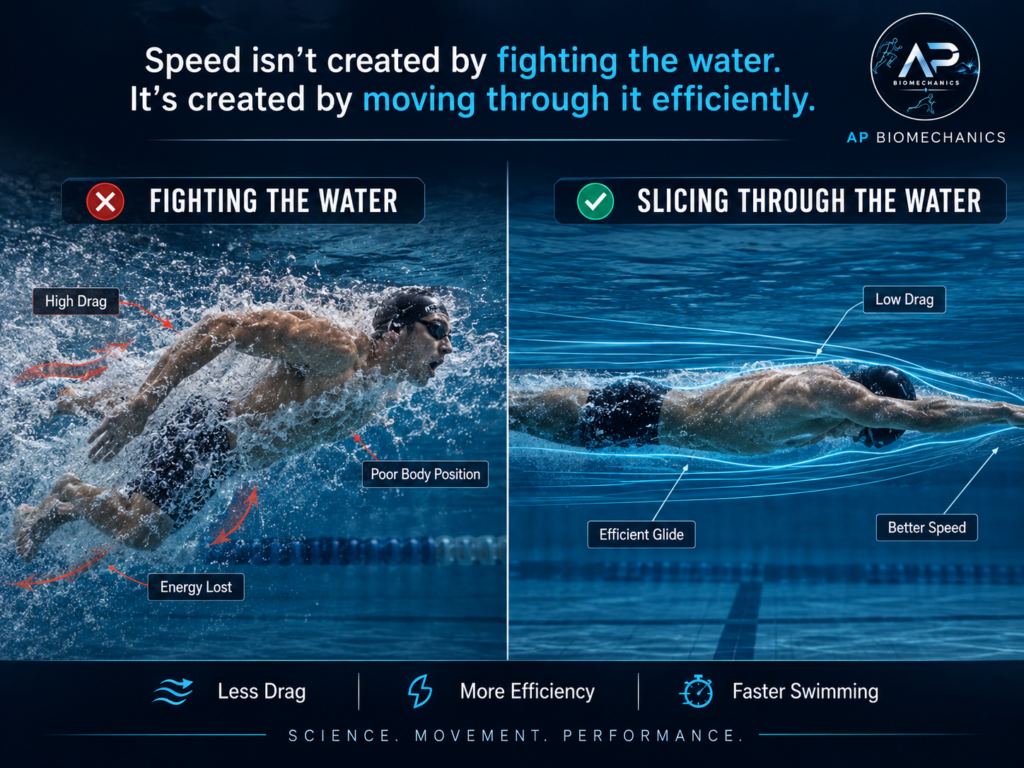
Imagine trying to run when someone holds onto you. It won’t make any difference by how strongly you push forward, that extra resistance will slow you down. Swimming works in almost the same way. Every incorrectly positioned hand, dropped elbow, bent knee, or lifted head becomes an invisible parachute.
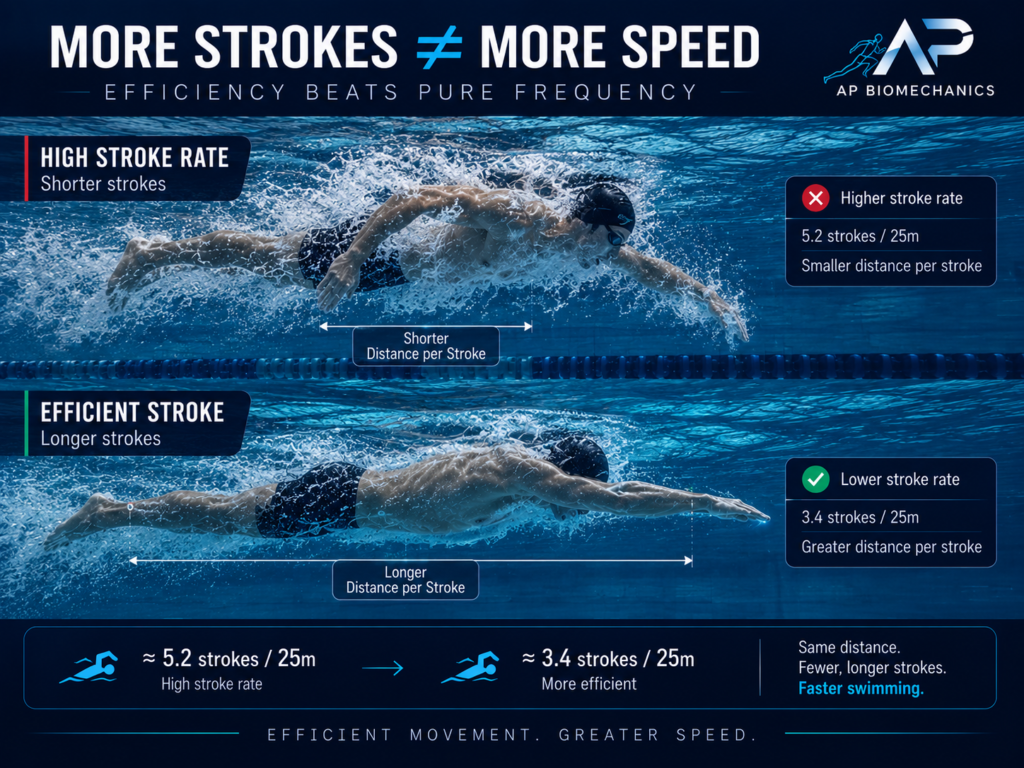
Many swimmers believe that rotating their arms faster will increase their speed automatically. In reality, increasing your stroke rate without focusing on good technique usually causes your distance per stroke to decrease. Instead of gliding efficiently through the water, you begin slipping, splashing, and fighting against it.
Elite swimmers understand a simple principle:
Don’t Fight the Water. Learn to Slice Through It
This is where biomechanics completely changes the way we think about swimming. Instead of asking ‘how can i become stronger’, biomechanics encourages you to think broader. It forces you to think:
How can i move with the least possible resistance?
This question has changed the way may Olympians train themselves, and it might also change the way you go about your next swim
The Science of Streamlining
Most swimmers believe that swimming faster simply means pulling harder or kicking faster. In reality, the greatest improvements often come from reducing resistance rather than increasing effort. This is where the science of streamlining becomes one of the most important principles in biomechanics.
Think about a F1 car. Engineers don’t simply put in a bigger engine- they spend countless hours improving structures so the car slices through the air with minimal resistance. Swimming follows the same principle. However, the challenge is much greater because water is almost 800 times denser than air. Even tiny changes in body position can dramatically increase the force opposing your movement.
This resistance is divided into two types: active drag and passive drag
Passive drag occurs when a person is gliding through the water without moving, such as pushing of the wall or just after diving. At this time, the body should be like a perfectly straight arrow. Each extra centimetre of surface area exposed to the water slows the swimmer down.
Active drag occurs when the swimmer is actually performing strokes. Every movement; be it a pull, kick or breath; changes body position. If these movements are not carefully coordinated, they create unnecessary resistance that acts like an invisible brake.
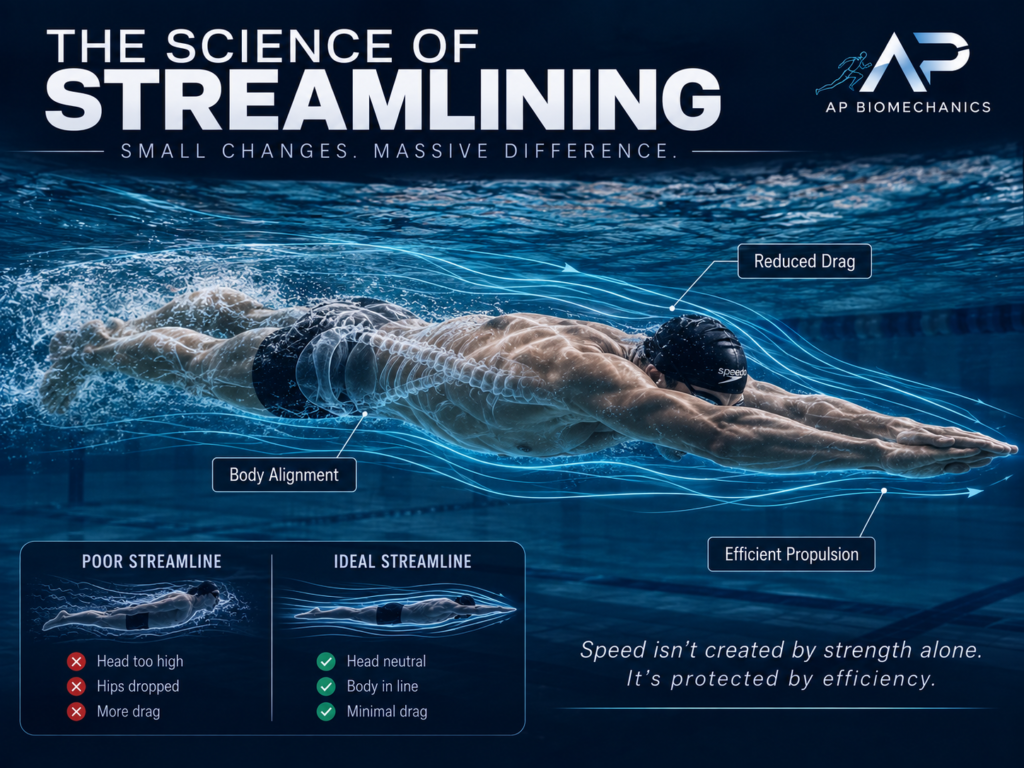
A common mistake made by swimmers is lifting their head too high while breathing. As the head rises, the hip region sinks. This increases the frontal surface area of their body. Instead of slicing through the water, they start pushing a large amount water forward.
Coaches often describe the ideal streamline as the
Human needle
The head stays balanced, the arms are extended fully towards the front, the core remains engaged and the legs are joined together. Although these changes may appear to be small , even a 1% improvement in body alignment can reduce drag noticeably over an entire race.
Elite swimmers understand that:
Speed isn’t created by overpowering the water- it comes from allowing the water to flow smoothly around the body.
When resistance decreases, every stroke becomes more efficient, requiring less energy to travel the same distance.
This is exactly why the best swimmers often appear effortless. Their goal simply isn’t to increase force, it is to waste as less of it as possible.
More Strokes ≠ More Speed
It is easy to assume that the swimmer moving their hands the fastest would be swimming the fastest too. After all, more strokes should mean more speed, right?
Not entirely.
Swimming speed is a balance of the stroke rate and the distance travelled per stroke. A swimmer may increase their stroke rate, but if the distance travelled per stroke is lesser, it may create extra drag and be a waste of energy.
Think of running, making smaller steps at a higher count does not necessarily make the runner faster than making long, efficient strides. Shockingly, swimming works in a similar way.
This is where stroke length becomes important.
A longer stroke allows a swimmer to travel farther with each cycle while maintaining a fixed streamline position. However, the end goal isn’t to make your stroke too long as this can interrupt rhythm and reduce propulsion.
The soft spot is a balanced technique: Enough stroke length to travel efficiently and a stroke rate that maintains momentum.
This becomes especially necessary during competitive swimming. Two swimmers may swim the same distance in the same number of strokes, but the swimmer who maintains better body alignment and produces propulsion more efficiently can preserve more of their speed between strokes.
This brings us back to our central idea of biomechanics:
Movement is not simply about how much force you produce. It is about what happens to that force.
A powerful stroke that creates unnecessary drag can be less effective than a controlled stroke that directs more of its force into forward motion.
For the swimmer, the question changes from, ” How hard can i pull?”, to something much more interesting:
How much distance can i move in each movement?
That is where technique starts turning effort into speed.
The Needle Position: Where Speed is Really Won
There is a time in each swim when the body either becomes streamlined or starts fighting the water.
Think of pushing a needle through the water. Its narrow shape allows it to move forward with very less disturbance. Now imagine replacing that needle with something much wider. The same force is no longer enough to move it efficiently because more water has to be pushed towards the side.
A swimmer faces the same problem
After the push, off the wall, the body should form one long, flat line: arms extended, hands aligned, head balanced, core engaged and hips close to the surface. This is the streamline position. It may look simple, but tiny changes can have a surprisingly large effect.
The hands should be particularly taken care of. If one hand crosses too much over the other, the shoulders rotate unnecessarily. If the hands separate, the body becomes wider. If the head lifts, the hips can drop. Each small change increases the amount of water the swimmer has to move around.
This is where the difference between passive drag and active drag becomes important.
Passive drag is the resistance created by the body moving through water simply. Active drag is the additional resistance created by the swimmer’s movements; such as an inefficient arm recovery, poor body position or excessive movement.
The goal isn’t to remove drag completely. That’s impossible. The goal is to avoid creating unnecessary drag.
This also explains why brute force has limits. A swimmer can produce more force from his/her muscles, but if that force is being used to overcome resistance created by inefficient technique, most of it is wasted.
Think of it like cycling with the brakes pressed. You can pedal harder, but you’re still working against something that shouldn’t be there.
For young swimmers especially, this is an important change in thinking. Getting faster isn’t always about becoming stronger. Sometimes it’s about becoming more efficient.
And that brings us back to the underwater phase.
The fastest swimmers don’t simply push harder against the water.
They find ways to make the water work with their movement.
The “Fifth Stroke”: Where Phelps Created His Advantage
Most swimmers think of a race as the strokes they take on the surface. Michael Phelps approached it differently.
For him, the underwater phase after every start and turn was not just a transition back into swimming. It was an opportunity to maintain, and even build -speed. This became known as the “fifth stroke”, referring to the underwater dolphin kick as another major source of propulsion along with the traditional strokes.
The difference begins the exact instant a swimmer leaves the wall.
A strong push, off the wall, gives the swimmer considerable speed without needing an immediate arm stroke. The challenge is to preserve that speed for as long as possible. This is where Phelps’ underwater technique became so effective.
Instead of perceiving the dolphin kick as simply moving the legs up and down, Phelps used his entire body as a movement system. The movement travelled from the upper body through the hips and into the legs and feet, creating a smooth wave like motion.
This matters because each part of the body contributes to the movement of the next. The chest initiates the motion, the core transfers it, the hips boost it, and the legs and feet finish it. Rather than several separate actions, the kick becomes one connected movement.
His ankle flexibility was another advantage. A flexible ankle can help the foot move more like a fin, allowing the swimmer to move more water backward and generate useful propulsion.
But perhaps the most interesting part is that the kick wasn’t simply about producing a large amount of force.
It was about producing force efficiently while maintaining a streamlined body.
Phelps also produced a powerful rhythm between the downward and upward phases of the kick. Instead of relying heavily on one direction, both phases contributed to propulsion. This helped maintain a more consistent velocity rather than creating repeated fast periods followed by noticeable the slower ones.
And that is the real learning behind the “fifth stroke”.
The underwater dolphin kick wasn’t magic, and it wasn’t simply about having extremely strong legs either.
It was a mix of streamline, timing, flexibility, coordination and force.
Phelps didn’t just kick harder
He turned his entire body into one connected system.
Stop Kicking Harder. Start Kicking Smarter.
One of the biggest misconceptions in swimming is that more force means more speed.
It sounds logical: push harder against the water, accelerate faster, finish the race sooner. But swimming doesn’t work quite that easily. Every extra movement also has the potential to create extra drag. The real challenge is finding the point where propulsion increases without allowing resistance to increase even more.
This is particularly important during the underwater dolphin kick.
A common mistake is to think of the dolphin kick as a powerful downward movement of the legs. The knees bend, the lower legs swing, and the swimmer tries to create as much force as possible. The problem is that this can break the streamlined shape of the body and cause the swimmer to push water in directions that don’t contribute efficiently to forward movement.
An effective dolphin kick is much more connected.
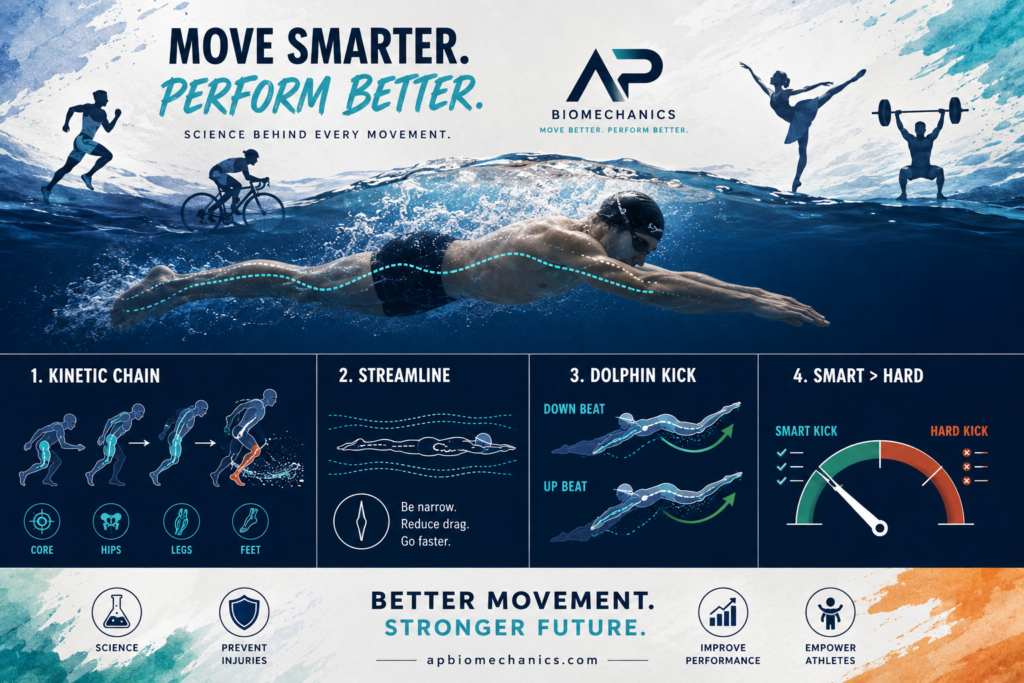
The movement begins around the body’s centre and travels through the hips, thighs, lower legs and feet. Rather than thinking “kick with my legs,” it is more useful to think
create a wave through my body
This is where the concept of a kinetic chain becomes important. Each segment contributes to the movement of the next. A small movement at the beginning can become significantly larger by the time it reaches the feet.
The feet then act as the final link in this chain, redirecting water backwards and helping maintain forward velocity.
There is another fascinating detail: propulsion can be produced during both the downward and upward phases of the dolphin kick. Instead of one massive kick followed by a recovery phase, a well-coordinated swimmer can make both directions contribute to movement.
The result is smoother acceleration and less unnecessary changes in speed.
This is why Phelps’ underwater movement was so difficult to replicate. It wasn’t simply about having powerful legs. It was about timing every part of the body so that power travelled in the right direction.
And that brings us back to the central idea of this blog:
Speed isn’t always about producing more force. Sometimes, it’s about wasting less of it.
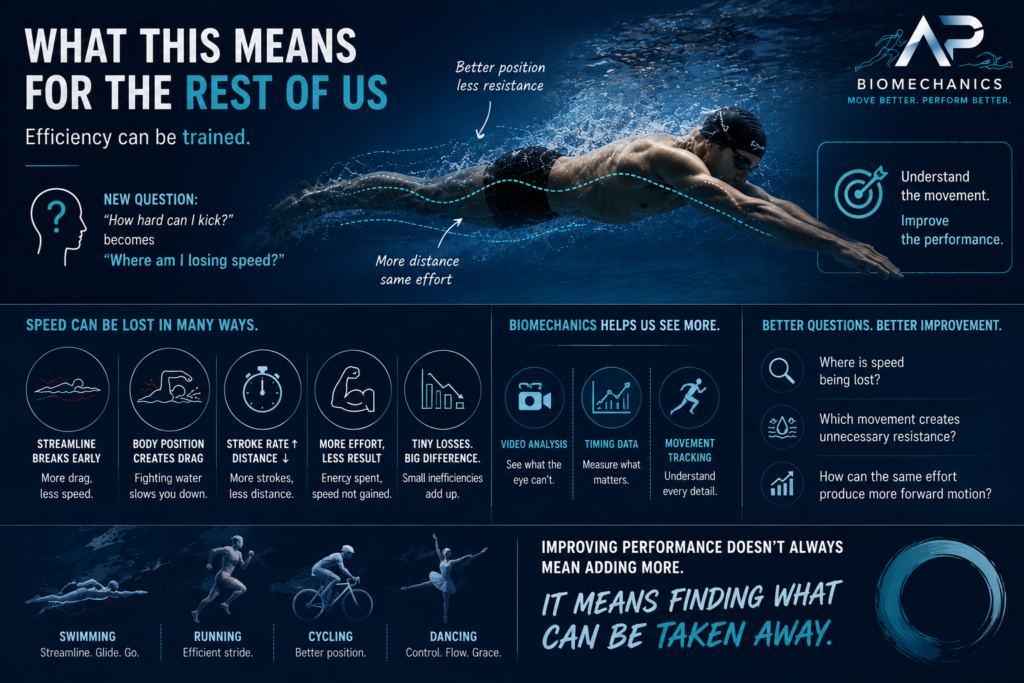
What This Means for the Rest of Us
The interesting thing about elite swimming isn’t that every swimmer should try to move exactly like Michael Phelps. It’s that his technique shows a much bigger principle: efficiency can be trained.
For a developing swimmer, this changes the question from “How hard can I kick?” to
Where am I losing speed?
Maybe the problem is a streamline that is being broken too early. Maybe the body position creates unnecessary resistance. Maybe the stroke rate is increasing while the distance travelled with each stroke is decreasing. Or perhaps a swimmer is putting too much effort into a movement that produces very little forward motion.
These differences can be difficult to notice when watching a swimmer in real time. This is where biomechanics becomes particularly useful. Video analysis, timing data and movement tracking can reveal details that the eye might miss.
Instead of simply telling an athlete to “swim faster,” coaches can ask questions like:
Where is speed being lost?
Which movement is creating unnecessary resistance?
How can the same effort produce more forward motion?
This applies far beyond swimming. A runner can examine stride efficiency. A cyclist can analyse body position. A dancer can study how force travels through a landing. Across sports, the goal is similar: understand the movement before trying to change it.
Sometimes improving performance doesn’t mean adding more
It means finding what can be taken away.
The Bigger Lesson: Swim Smarter, Not Harder
The idea behind the “fifth stroke” stretches far beyond the 15-metre underwater zone. It shows us something fundamental about sport:
Performance is not simply about how much effort an athlete can produce, but how effectively that effort is used
Two swimmers can train for the same number of hours, have similar strength and fitness, and still move through the water differently. One may be fighting the water with every movement, while the other has learned to work with it.
That difference is what makes biomechanics so fascinating.
It allows us to look beyond the stopwatch and ask what is actually happening between the start and the finish. Where is energy being lost? Which movements create useful propulsion? Which ones create unnecessary resistance? And most importantly, can the movement be changed before inefficiency becomes a habit?
This matters especially for younger athletes. Developing good movement patterns early doesn’t mean chasing perfection. It means learning to understand your own movement and becoming curious about why something works, or doesn’t.
The goal isn’t to turn every athlete into a scientist. It’s to give athletes better questions to ask.
Because the fastest swimmer isn’t necessarily the one who works the hardest.
Sometimes, it’s the one who has learned to make every movement count.
And perhaps that’s the real secret behind the fifth stroke:
not more power, but better movement.