
The biomechanics behind acceleration, agility and changing direction
The Illusion Of Speed
Watch a football match and there is always that one player who seems to move differently.
They aren’t necessarily running at an unbelievable speed. They just seem to get there first. They accelerate suddenly, slow down without losing balance and change direction before the defender has even reacted. What makes it even more interesting is that their movements never look particularly difficult.
Then you watch another player try the same thing. They may run just as fast, but their movements look heavier and different. Their first few steps aren’t as sharp, their turns take longer and they look like they are putting in much more effort. So what creates that difference?
It is an understatement to say that the answer is just strength. Stronger legs should ideally produce more force, and more force should mean more speed. But football makes things a little more complicated.A footballer usually never gets to run in a straight line for a very long time. A player might sprint towards the ball, suddenly stop, turn around, accelerate again and then pass; all within a few seconds.
That means being a good footballer isn’t just about producing force.
It is about controlling force.
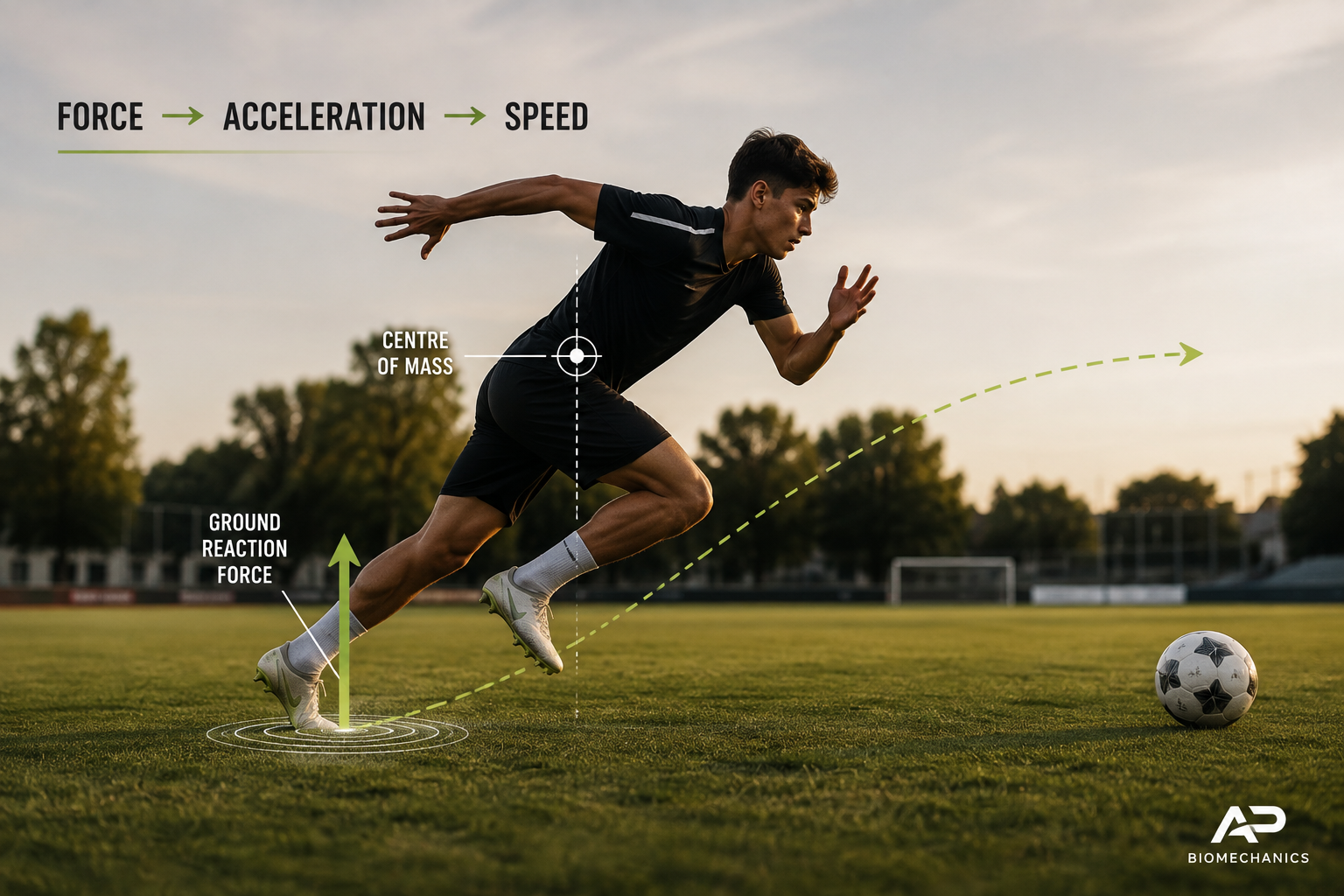
Every time a player pushes their foot against the ground, the ground pushes back. During acceleration, the player needs to direct this force in a way that helps move their body forward.
Even the smallest of differences matter.
Where the foot lands
How much the body leans
Where the centre of mass is positioned
How quickly the player can move from one step to the next
None of these things look particularly dramatic on their own. But when put together, they can completely change how efficiently a player moves. This is what makes biomechanics so interesting to me. We usually watch football and focus on the obvious things; the goal, the tackle, the sprint or the skill.
Biomechanics makes you look at what happens between those moments. The tiny adjustments that most people never notice may be what allow an athlete to perform the movement in the first place.
So perhaps the “effortless” footballer isn’t actually using less effort. Maybe they’re simply getting more movement from the effort they already produce.
The First Three Steps
When we think about a footballer’s speed, we usually imagine their maximum speed. But in an actual match, reaching top speed isn’t always the most important thing. For instance, a midfielder might only have a few metres before an opponent gets to the ball. In that situation, those first few steps can matter much more than how fast they could eventually run.
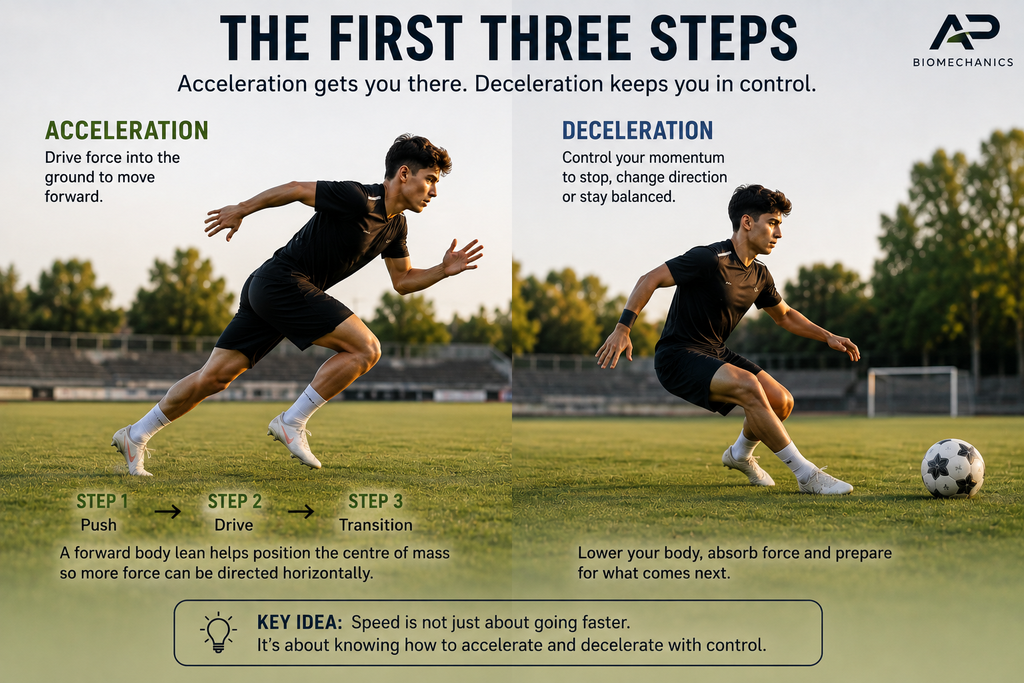
Acceleration is the ability to increase speed, and it depends majorly on how effectively an athlete applies force to the ground. During the first steps of a sprint, a footballer usually leans forwards. This helps position their body so that they can produce more force in the direction they want to move. As they gain speed, their body gradually becomes upright.
It sounds simple, but there is a lot happening in those few moments. The player’s centre of mass is constantly changing, while the hips, knees and ankles work collectively to push against the ground. The timing of each step also matters. If the foot lands in the wrong position, some of the force can work against the movement instead of helping it. This is why two players with similar physical strength can still accelerate differently.
But there is another side to speed that is just as important- stopping. Footballers don’t spend the whole match sprinting forwards. They repeatedly have to slow down, change direction and accelerate again. A player chasing the ball might suddenly need to stop before turning, or a defender might have to slow down to stay in front of an attacker. That means a footballer’s body isn’t just producing force, it is also absorbing and controlling it.
In a way, acceleration and deceleration are two sides of the same problem. One helps you move faster, the other helps you control what happens once you’re moving. And in football, being able to do both quickly can make a huge difference.
The Secret Behind the Sudden Cut
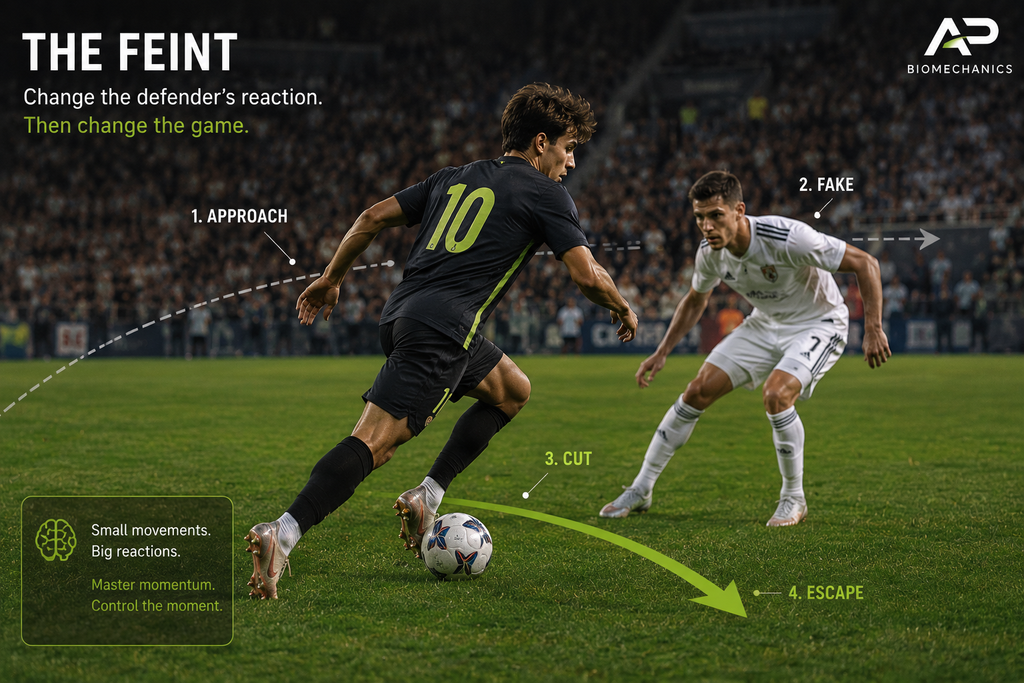
Have you ever watched a footballer run towards a defender, make one tiny movement with their body and suddenly disappear in the opposite direction?
The defender knows the player is coming. They can see the ball. They are ready to react. And yet somehow, they still get beaten. Though it looks like a trick, in reality, part of it is physics.
A footballer who is already moving has momentum. Their body has a tendency to keep travelling in the same direction unless any external force acts on it. So when a player suddenly cuts left, they can’t simply turn their body and expect to instantly move left. They first have to manage the momentum they have already.
This is where good footballers become really interesting to watch.
Instead of making one huge movement, they often use small changes in their body position to make the defender believe they are going somewhere else. A slight drop of the shoulder, a change in hip position or a tiny shift in the direction of the next step can be enough to make an opponent react.
The attacker hasn’t necessarily become faster. They have simply made the defender move first.
Then comes the cut.
The player brakes just enough to control their forward momentum, plants the foot and pushes into the new direction. Their muscles have to deal with the forces created during braking before producing force for acceleration again. This is why changing direction repeatedly is difficult. The body is constantly switching between absorbing force and producing force.
And there is another factor; friction. A footballer’s boots need enough grip with the ground to allow them to push and redirect their body. With too little grip the player cannot generate enough force to change direction properly. But movement isn’t simply about having as much grip as possible either; the interaction between the player, footwear and playing surface affects how forces are transferred.
Suddenly, that dramatic dribble we see on the screen becomes much more than a football skill. It is a combination of momentum, friction, reaction time and body control. And perhaps the most impressive part is how quickly the player manages all of it.
The defender sees a footballer. Biomechanics sees a body trying to change its momentum in a fraction of a second. That difference in perspective is exactly what makes analysing sport so fascinating.
When Your Body Becomes the Limiter
A footballer can have extraordinary technique, quick reactions and plenty of speed, but there is one thing they cannot escape: their body still has to handle the forces they generate.
Think about what happens during a match.
A player might sprint, suddenly stop, twist to change direction, jump for a header and land before immediately sprinting again. None of these movements seem unusual on their own. The problem is what happens when they are repeated again and again, especially when the player becomes tired
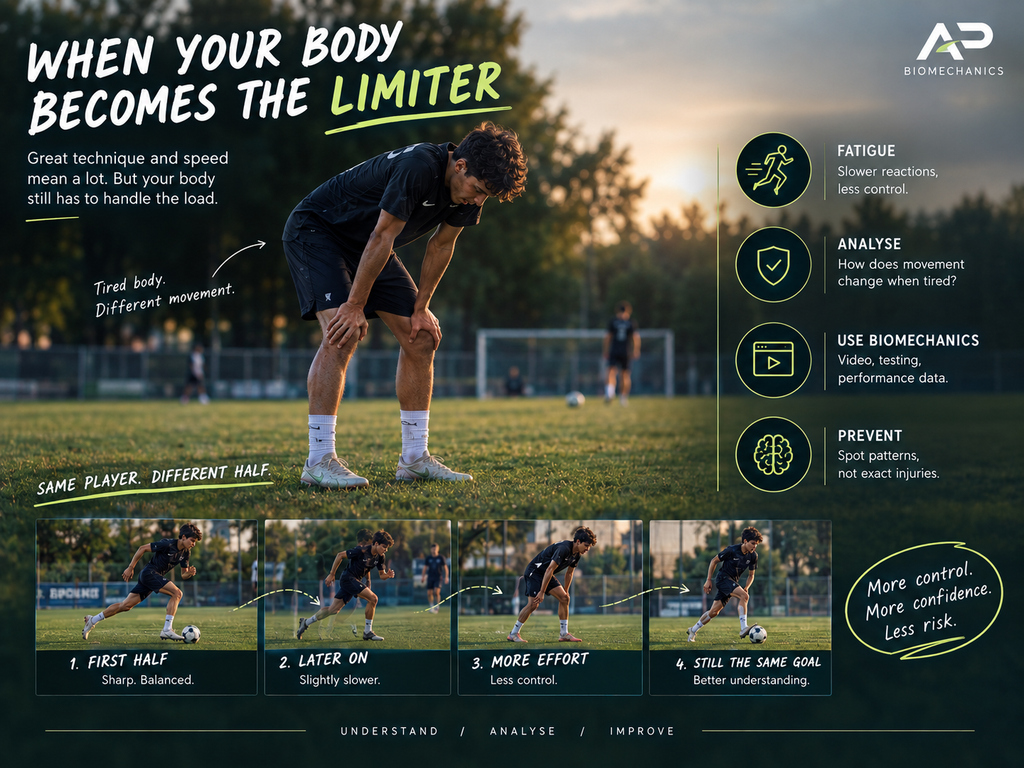
Fatigue can change movement.
A player who was perfectly in balance in the first half might start taking a little different steps later in the game. Their reactions may slow down, their control can decrease and their technique may become less consistent. But, this doesn’t mean fatigue automatically causes an injury. It simply means the body may have to work harder to control the movements that were easier to perform earlier.
This is where biomechanics can be useful.
Instead of only asking, “Is this player fast?”, we can ask questions like:
How does the player’s movement change when they get fatigued
Do they still control their body during a sudden change of direction?
Are they landing and braking in the same way?
These are just a few questions that coaches and sports scientists can investigate through video analysis, movement testing and other forms of performance data. And this matters because injury prevention isn’t about predicting exactly when an injury will happen, it is about understanding movement well enough to spot patterns that may need attention.
For a young footballer especially, this idea is important. The goal shouldn’t be to make movement look perfect, it should be to help the athlete understand their own movement, develop control and perform with confidence.
Because sometimes, the biggest improvement isn’t adding more power. It’s learning how to control the power you already have.
The Ball Changes Everything
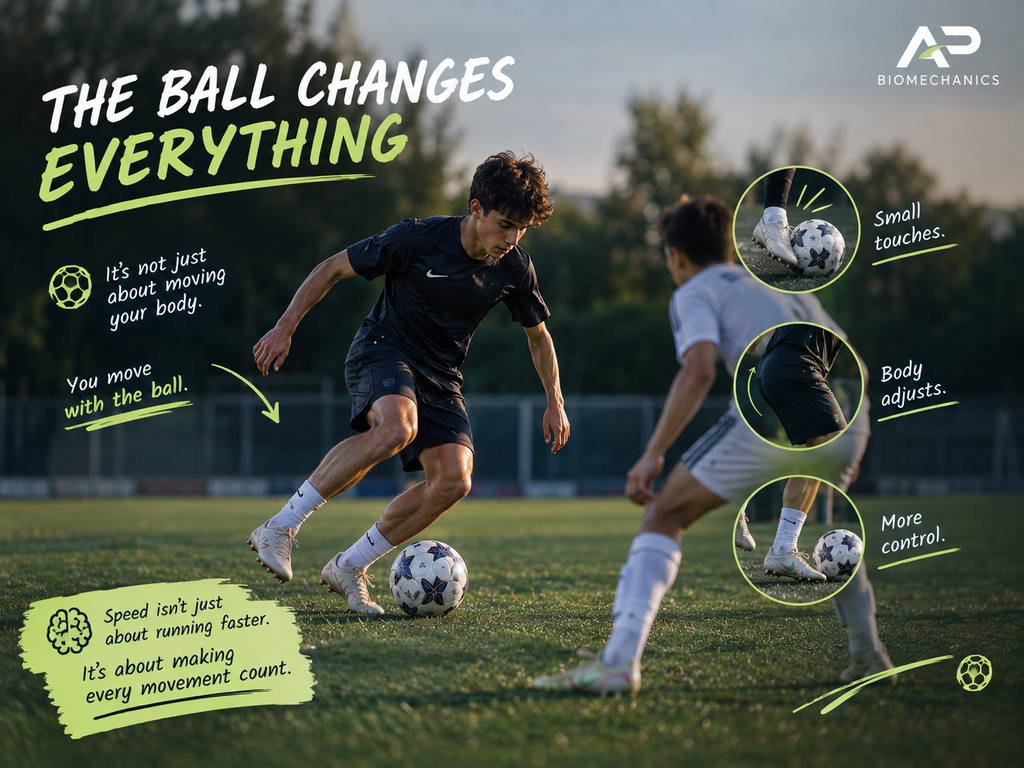
However, there is one thing that makes football different from simply sprinting around a field, you have to control a ball while doing the same. A player can’t just focus on where there body is going, they have to think about where the ball is going too.
Watch a good dribbler closely and you will notice that their touches are usually tiny. The ball stays close enough that they can change direction quickly without having to chase after it.
But it isn’t just about their feet, their entire body is constantly adjusting. A minor shift in the hips, a change in balance or a quick movement of the upper body can prepare them for the next touch.
This is where coordination becomes just as important as speed. A player who takes a huge touch might technically be running faster, but they have also given the defender an allowance of a higher reaction time. A smaller touch keeps the ball under control and allows the player to change their movement almost immediately.
That’s exactly why some footballers seem to have the ball stuck to their feet. They’re not moving randomly, they’re constantly controlling where their body, the ball and what their next movement will be.
Sometimes, that control is what creates the speed in the first place.
Efficiency goes greater than effort
This is something I find particularly interesting: doing more doesn’t always mean doing better.
A footballer can take bigger steps, swing their arms harder and try to sprint at maximum effort. But if their movement isn’t well coordinated, some of that effort is basically wasted.
Elite players often look effortless because their movements are connected. Their muscles and joints work together instead of fighting against each other. It is somewhat like driving a car. Pressing the accelerator harder doesn’t help if you’re constantly turning the wheel in the wrong direction.
The same idea applies to football. Good biomechanics isn’t about using the most force.
It’s about using the right force, at the right time, in the right direction
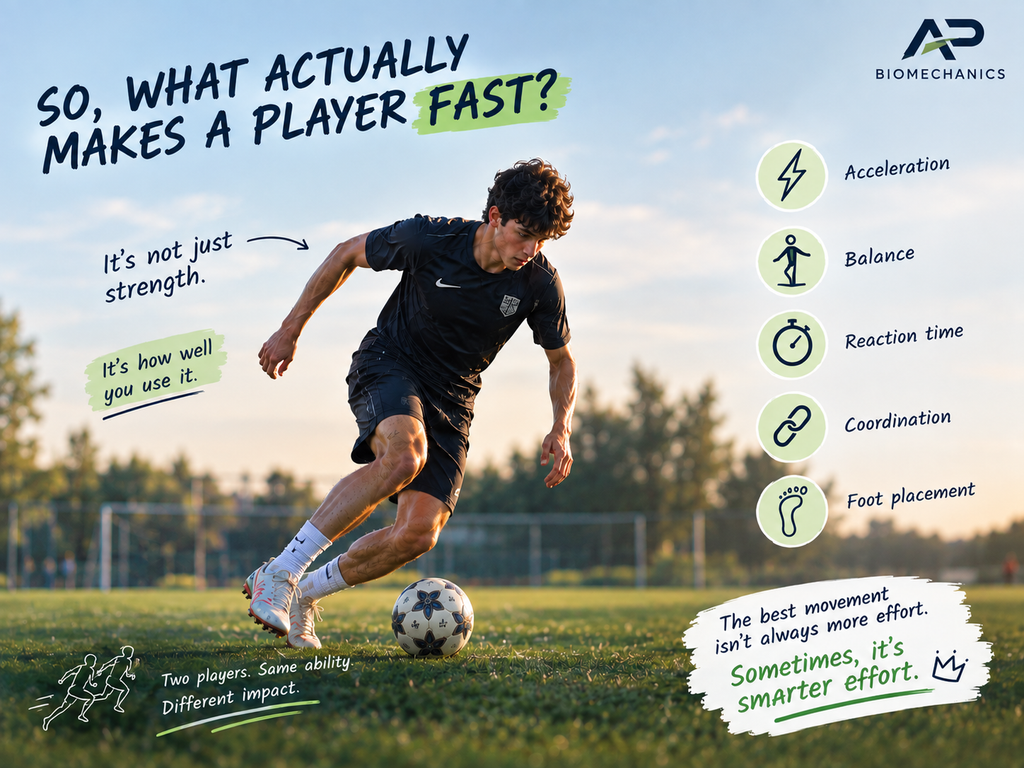
So what actually makes a player fast?
After looking at all of this, I think the biggest takeaway is quite simple:
Speed isn’t just all about strength. It’s about how a player can use their strength.
Acceleration, balance, reaction time, coordination and even something as small as where the foot lands can change the way a player moves entirely.
And that’s what makes football so interesting from the biomechanics perspective. Two players can have similar capability, but the one who uses their body more efficiently can have a completely different impact on the pitch.
Maybe the fastest player isn’t always the one running the hardest. Maybe it’s the one who knows when to push, when to slow down and where to put every movement. That difference is what biomechanics helps us to see.
The best movement isn’t always more effort.
Sometimes, it’s smarter effort.

Exceptional blog. Additionally, the explanation about the importance of biomechanics is well explained and precise.