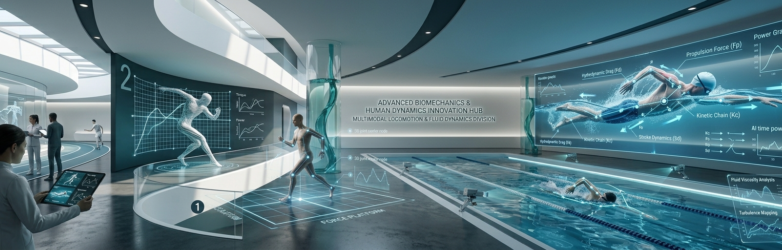

How a Small Injury Can Create the Biggest of Questions
It was a Tuesday. I remember because I had just finished a two-hour swim practice before rushing to ballet rehearsal. By the time I got home, my right foot was whispering something I chose to ignore. But whispers have a way of turning into shouts. Three days later, I couldn’t stop thinking about that faint ache on the outer edge of my foot – not because it hurt, but because I had no idea why it was there. That question changed everything.
As a girl who spends hours juggling between two hobbies which are very different from each other -swimming and ballet- I started questioning whether any of those had contributed to this pain. Was it the few times I experienced a jerk while explosively pushing off the wall after a turn? Was it the countless number of hours I spent pointing my toes, balancing on one foot, or landing from jumps in ballet? Or, was it just a simple mixture of both? I had absolutely no answer.
That lack of surety sparked something much more than just the cure- it sparked curiosity. Instead of pondering upon “ how to make this pain disappear?”, I started asking something that I had never thought of ,”what happens in my body every time I move?”
That question led me to discovering biomechanics.
Not Just Muscles and Bones
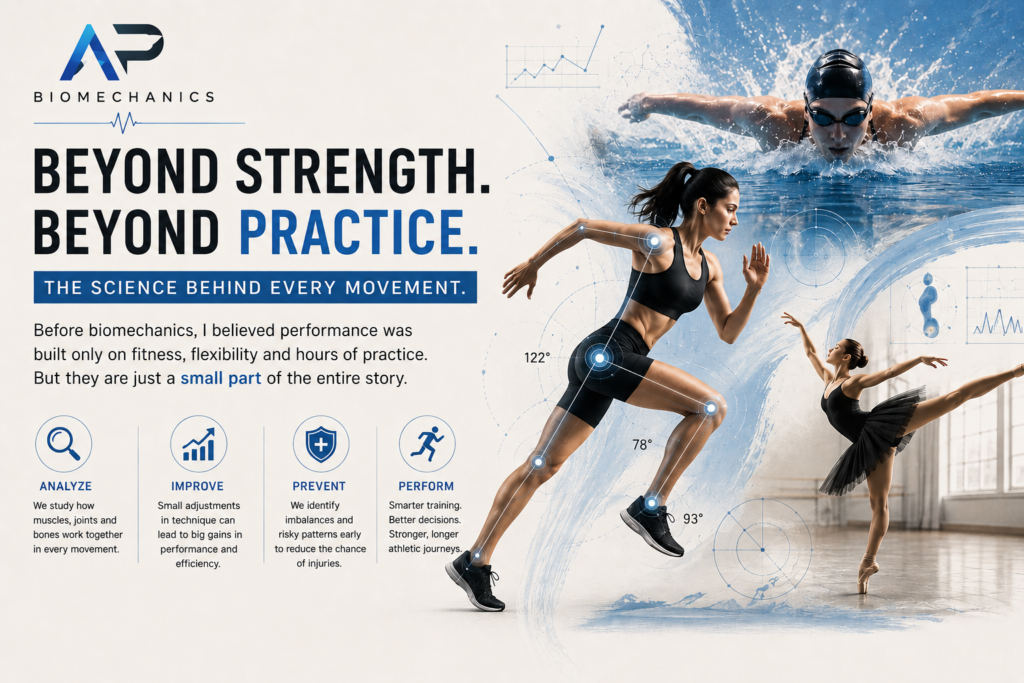
Before I started knowing more about what biomechanics was, I thought that athletic performance depended mostly on fitness, flexibility and hours of practice. Along with these certainly being important, I realised that they were just a small part of the entire story.
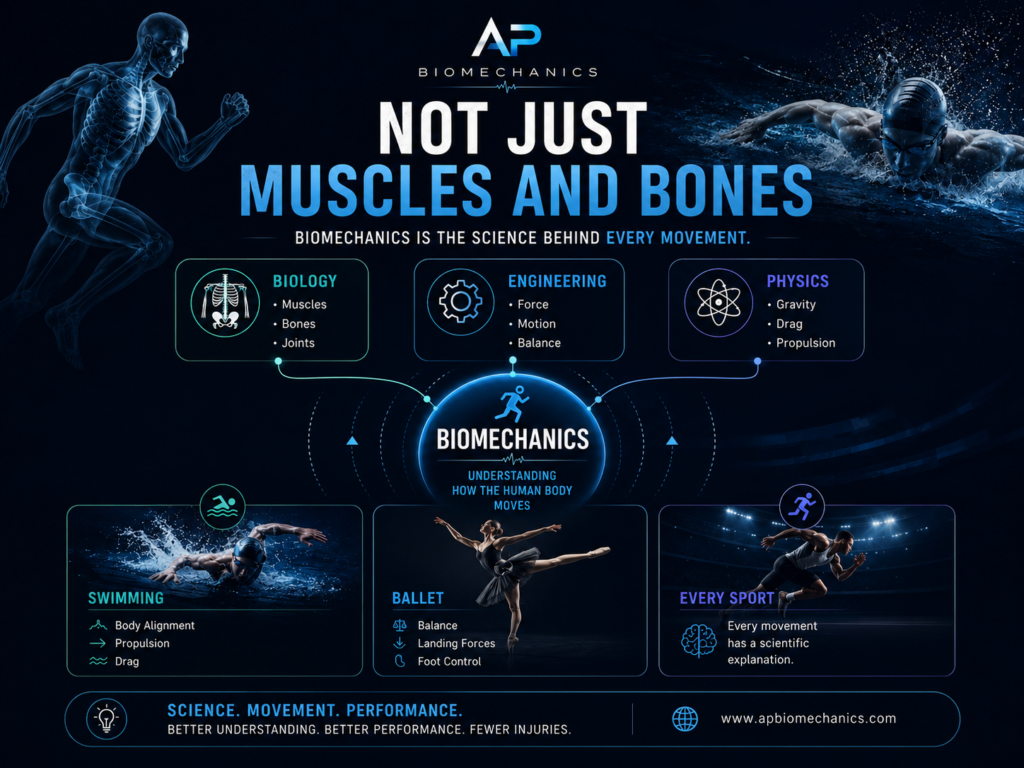
Biomechanics is the science of learning how the human body moves, by combining the principles of biology, physics and engineering. It is the study of how muscles generate force, how joints move, how bones support our body and how external forces like gravity and water resistance affect every movement we make.
According to the American Society of Biomechanics, biomechanics applies the laws of mechanics and physics to understand human movement and structure[^1].
Similarly, the International Society of Biomechanics in Sports defines it as the study of the effects of internal and external forces on the human body during athletic performance[^2].
These principles have been used for decades to help athletes optimize technique and reduce injury risk.
Suddenly, sports felt different.
Swimmers weren’t just moving through water- they were controlling drag, propulsion and body alignment. Ballerinas weren’t just dancing- they were carefully managing balance, force distribution and joint positioning with every single leap and landing they made.
Every movement had a scientific explanation waiting to be explored.
Could My Sports Have Played a Role
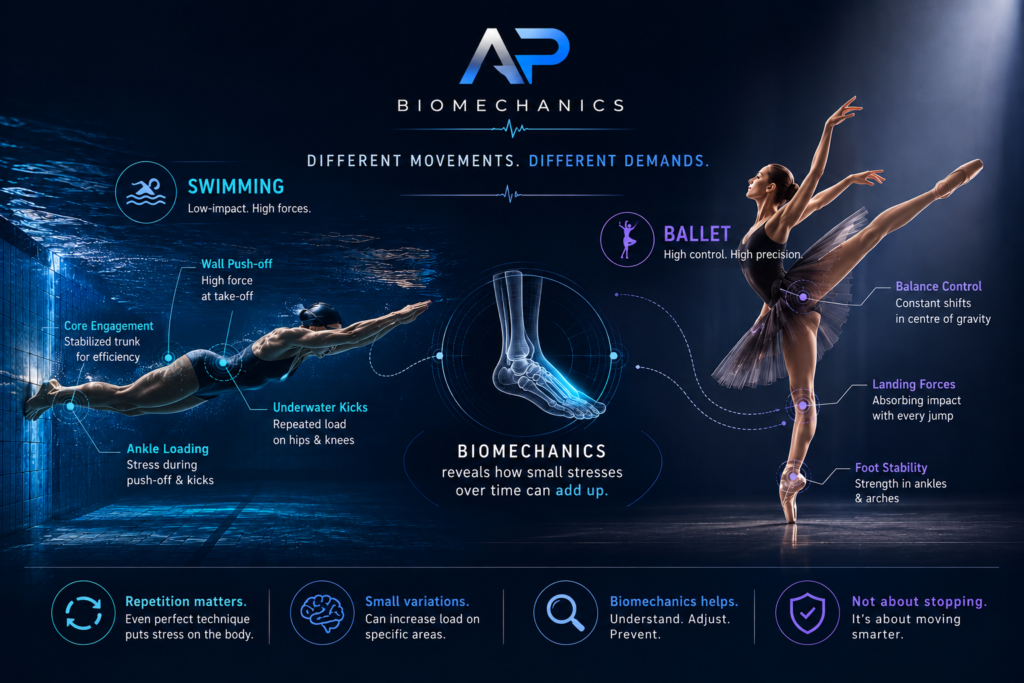
Although I still don’t know the cause of my foot pain, learning about biomechanics made me realise how both of my sports placed very different demands on my body.
Swimming is often considered as a low-impact sport as the water supports much of our weight. However, swimmers repeatedly generate extreme forces when diving into the pool, pushing off the wall during turns and performing underwater dolphin kicks. Something even as simple as pointing our toes for long periods changes how the muscles in the foot and the ankle are used.
Ballet, on the contrary, poses an entirely different challenge. Dancers constantly point their toes, balance on one leg, perform jumps and absorb landing forces with remarkable precision. Every rehearsal involves hundreds of carefully controlled movements that require exceptional strength and stability in the ankles and the feet.
Neither sport is harmful. In fact, both build incredible strength, coordination and discipline. However, biomechanics teaches us that repetition matters. Even efficient movements, when repeated thousands of times, place stress on specific parts of the body. Small variations in technique, strength or recovery may gradually increase the load on one part of the body.
That got me intrigued.
Rather than seeing injuries and minor accidents, biomechanics motivates us to find whether the movement itself can give some clues.
Looking Beyond Performance
By the term Sports Science, people usually think about either getting faster, jumping higher or swimming faster.
These improvements are definitely possible. But what is more important is how they can be achieved along with preventing any injury that can possibly take place during the process.
Just imagine if coaches could identify movement techniques that added stress to an athlete’s knees even before it started aching in the first place. Imagine if a swimmers under-water push off could be adjusted to reduce unnecessary strain on the ankles. Imagine if a dancer’s landing mechanics could be improved before repetitive stress caused an injury. This is where biomechanics comes to the clear picture.
Instead of waiting until something hurts, biomechanics studies movement early enough to recognize any technique that may increase the risk of getting injured.
For younger athletes especially, this can result in longer and healthier sporting careers.
CASE STUDY: Michael Phelps' underwater dolphin kick analysis

From a biomechanical perspective, Michael Phelps’ underwater dolphin kick is an engineering marvel of fluid dynamics, but its extreme repetitive strain requires precise injury prevention strategies. The kick acts as a kinetic whip, generating massive propulsion through hip flexion and hyperextension that transfers directly down the lower kinetic chain.


Biomechanical Strain and Injury Risks

Lumbar Spine Hyperextension: The high amplitude nature of the dolphin kick puts intense pressure on the lower back. Repetitive hyperextension during the upward phase can lead to lumbar facet joint irritation or spondylolysis (stress fractures).

Patellofemoral Knee Stress: While the kick should originate from the hips, the sudden snapping motion of the knees during the down-kick creates massive shear stress on the kneecap, increasing the risk of patellar tendinitis.

Ankle Instability: Phelps possessed hyper-flexible ankles, but for swimmers trying to replicate this without adequate strength, extreme plantarflexion can lead to anterior ankle impingement or strain of the extensor tendons.


Preventive Strategies

Core and Pelvic Stabilization: Swimmers must build deep abdominal and gluteal strength to prevent the lumbar spine from taking the brunt of the kick's force. Exercises like deadbugs, planks, and bird-dogs teach the body to drive the kick from the pelvis rather than bending solely at the lower back.

Balanced Lower Body Strength: Focus on eccentric quad strength and hamstring power to balance the knee-snapping action and protect the patella.

Progressive Flexibility Training: Enhance ankle mobility through soft-tissue work (foam rolling the calves and shins) and dynamic stretching, ensuring flexibility is backed by joint stability so the ankle does not become hyper-lax and injury-prone.
If you are incorporating more dolphin kicking into your training, tell me:
I can suggest specific prehab exercises to safeguard your spine and joints. Drop your current challenges below for a personalised biomechanical breakdown.
Do you currently experience any lower back stiffness or knee pain?
What dryland routine do you currently follow?
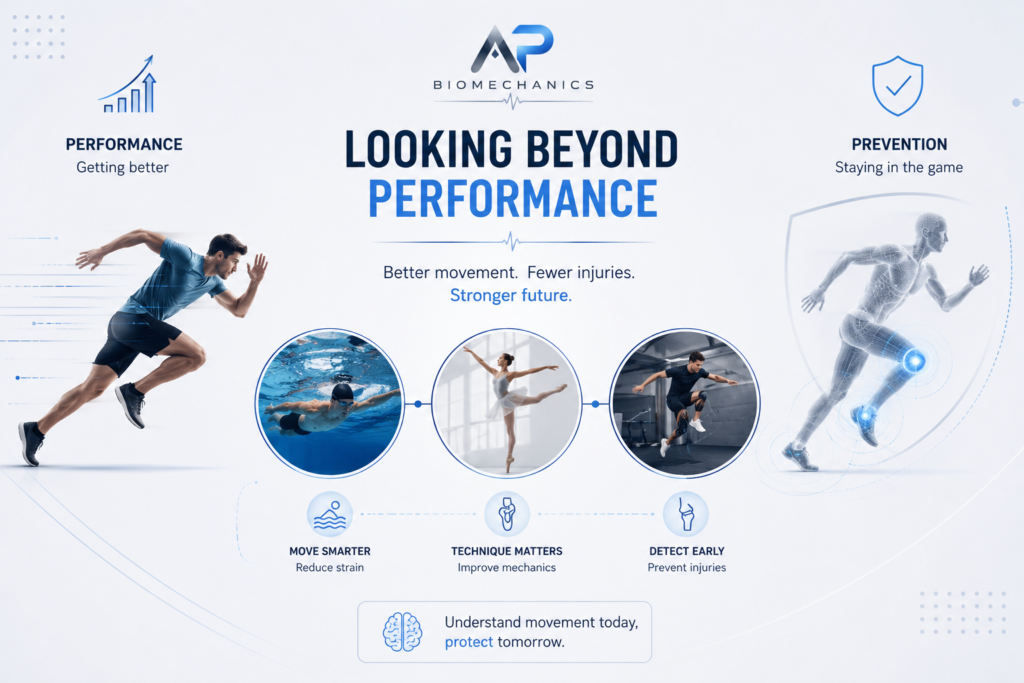
Technology is Changing the Way We Understand Movement
One of the most engaging things I learnt was how technology changed biomechanics over time.
Scientists use high-speed cameras to slow down movements that take place within the smallest fractions of a second. Motion capture sensors trace down every movement of each and every joint in an athlete’s body. Pressure sensitive platforms measure how force travels through the feet. Wearable sensors can monitor balance, acceleration and movement patterns during training.
These tools don’t replace coaches – they give them better information.
Instead of depending only on observation, athletes can receive objective criticism about how they move.
As technology becomes more affordable and accessible, I believe these tools won’t remain limited to Olympic training centres. Schools, academies and local sports clubs may increasingly use them to help athletes train smarter and stay healthier.
The Next Generation Needs More Than Just Talent
Today’s athletes grow up surrounded by technology, data and innovation. Success is no longer determined solely by natural ability or hard work. It also depends on understanding the body itself. Learning about biomechanics doesn’t mean every student has to become a scientist. It simply means becoming more curious.
Why does one runner move more efficiently than another? Why do elite swimmers maintain almost perfect body alignment? Why do some athletes remain injury-free despite years of intense training?
Questions like these don’t take away the excitement of sport – they make it even more fascinating.
Curiosity is the First Step Towards Prevention
Looking back, I’m actually grateful that my foot injury made me stop and ask questions. Not because I enjoyed being injured, but because it introduced me to a field that combines everything I love: sport, science and problem-solving.
I still don’t know exactly what caused the pain along the outer edge of my right foot. It may have been related to training load, movement technique, recovery or a combination of several factors. Without proper assessment, it would be impossible to say for certain.
But that’s exactly the point. Biomechanics doesn’t encourage us to jump to conclusions. It encourages us to investigate.
As both a swimmer and a ballerina, I’ve started watching movement differently- not only my own, but everyone else’s too. Every dive, every pirouette, every sprint and every landing is an opportunity to ask another question.
For me, biomechanics isn’t simply about improving performance. It’s about understanding the incredible machine that allows us to move and using that understanding to help athletes perform better, recover smarter and, most importantly, prevent injuries before they happen.
My foot still reminds me of that injury from time to time. But now, instead of ignoring it, I listen. Biomechanics taught me that every ache is a conversation, every movement a clue, and every question an opportunity. If you’re a young athlete reading this, don’t wait for pain to make you curious. Start asking ‘why’ today – because understanding your body isn’t just about performing better. It’s about protecting the one thing that makes every sport possible: you
Have you ever wondered why your body moves the way it does?
Drop your thoughts in the comments section below.
Your next injury might be trying to tell you something.
References:
[^1]: American Society of Biomechanics. (n.d.). *What is Biomechanics?* Retrieved from https://asbweb.org
[^2]: International Society of Biomechanics in Sports. (n.d.). *About ISBS*. Retrieved from https://isbs.org
What an incredible way to explain the working of biomechanics and loved the case study. Brilliant work done.
Excellent article on how understanding of biomechanics can improve performance for athletes and help avoid injuries in our day to…


Excellent article on how understanding of biomechanics can improve performance for athletes and help avoid injuries in our day to day life!
What an incredible way to explain the working of biomechanics and loved the case study. Brilliant work done.